
Switching VoIP providers doesn’t mean abandoning your established business phone number. Number porting, officially called Local Number Portability (LNP), transfers your existing phone number to Contactivity’s VoIP system within 3-7 business days without service interruption. This FCC-regulated process maintains your brand identity, customer relationships, and professional credibility while you upgrade to superior communication technology.
For small business owners concerned about customer contact continuity and IT managers requiring predictable migration timelines, Contactivity delivers a streamlined porting process with dedicated specialist support, 95% first-attempt success rates, and zero downtime guarantees.
What Is Number Porting (LNP)?
Number porting is the FCC-regulated process enabling businesses to transfer existing phone numbers from one telecommunications provider to another. The Telecommunications Act of 1996 established Local Number Portability (LNP), giving customers the legal right to keep phone numbers when switching carriers.
During number porting, Contactivity (the winning carrier) coordinates with your current provider (the losing carrier) to transfer routing information without changing your actual phone number digits.
The process operates at the network infrastructure level through carrier coordination systems. Routing tables update to direct incoming calls to Contactivity’s VoIP platform instead of your previous provider’s network.
LNP applies to local phone numbers, toll-free numbers (800, 888, 877, 866, 855, 844, 833), and virtual numbers assigned to geographic area codes. The federal mandate ensures telecommunications providers cannot refuse legitimate porting requests or impose unreasonable delays, protecting consumer choice in the competitive communications market.
Why Keeping Your Business Number Matters
Brand Identity Continuity
Your business phone number represents years of brand-building investment. Marketing materials, business cards, website headers, email signatures, vehicle wraps, and directory listings all display this contact information.
Changing your phone number forces expensive reprints averaging $2,000-$5,000 for established SMBs, disrupts brand recognition, and creates customer confusion during the transition period.
Number porting eliminates these costs entirely. Your phone number remains identical, preserving the brand equity you’ve built through consistent customer contact over months or years.
Operational Efficiency
Small business owner Sarah spent three years establishing her consulting firm’s brand through her business phone number. When evaluating VoIP providers, she calculated that notifying 500+ clients, updating 12 online directories, reprinting marketing materials, and changing CRM records would consume 40+ administrative hours and cost $3,000+. Number porting eliminated this burden completely her clients experienced seamless continuity while she gained advanced VoIP features.
IT manager Ian manages communications for a 45-person distributed team. Changing phone numbers would require updating internal systems, CRM databases, vendor contacts, client records, automated notification systems, and employee documentation. This coordination typically demands 60-80 work hours across multiple departments. Number porting reduced Ian’s migration timeline from weeks to days with zero internal system changes required.
Customer Trust Preservation
Research from telecommunications industry studies indicates businesses lose 15-25% of customer contacts when changing phone numbers. Regular customers who stored your old number in their phones cannot reach you. New prospects visiting outdated directory listings encounter disconnected numbers. Long-time clients questioning the number change may suspect business instability or closure.
Number porting maintains the established trust signal your phone number provides. Customers recognize the familiar contact information, experience no disruption in reaching your team, and perceive business stability through consistent communication channels.
How Number Porting Works with Contactivity?
Step 1: Verify Number Portability
Check if your phone number qualifies for porting by confirming account ownership with your current provider. The number must be active, the account must be in good standing with no outstanding balances, and you must be the authorized account holder or have proper authorization. Local numbers, toll-free numbers, and most VoIP numbers are portable, though some specialized number types may face restrictions.
Contactivity’s porting specialists conduct pre-qualification checks to identify potential eligibility issues before formal submission, preventing delays from unportable number types or account problems.
Step 2: Gather Required Documents
Number porting requires specific documentation proving account ownership and authorization:
Letter of Authorization (LOA): This signed document authorizes the number transfer to Contactivity. The LOA must include the authorized signer’s name, title, signature, and date. Business name spelling, account details, and authorized signer information must match your current provider’s records exactly—even minor discrepancies like “Inc.” versus “Incorporated” trigger rejection.
Recent Phone Bill: A bill dated within 30 days proves account ownership and active status. The bill must clearly show your account number, business name, billing address, and the phone numbers you’re porting.
Account Information: You’ll need your complete account number from the current provider, any account PIN or password required by the losing carrier, and the billing telephone number (BTN) for multi-line accounts.
Contactivity provides LOA templates and conducts pre-submission document reviews, validating information accuracy before carrier submission. This proactive approach reduces rejection rates from the industry average of 22% to below 5%.
Step 3: Submit Porting Request to Contactivity
Complete Contactivity’s online porting request form with your account details, desired port date, and contact information. Upload the signed LOA, recent bill copy, and account documentation through the secure portal. Contactivity validates your submission within 24 hours for requests received before 2 PM EST, identifying any corrections needed before carrier coordination begins.
The validation process confirms account details match your current provider’s records, including business name spelling, billing address accuracy, and account number correctness. If discrepancies exist, Contactivity’s porting team contacts you immediately with specific correction requirements, preventing rejection delays that extend timelines by 7-10 business days.
Step 4: Validation and Carrier Coordination
Contactivity submits the validated port request to your losing carrier through industry-standard porting systems. The losing carrier reviews the request, confirms account ownership, verifies the authorized signer matches their records, and approves the port date. This carrier coordination phase typically requires 2-4 business days, though some providers process requests faster based on their internal procedures.
Contactivity maintains established relationships with major telecommunications carriers, streamlining coordination and resolving disputes efficiently. The porting specialist assigned to your request monitors progress daily, providing status updates and escalating any carrier delays that threaten timeline commitments.
Step 5: Port Execution (Scheduled Date)
On the scheduled port date, routing information updates at the carrier network level during a brief transition window typically lasting 5-15 minutes. Contactivity configures advance call forwarding to maintain service continuity throughout this transition. The port typically executes during evening hours or weekends to minimize potential impact on business operations.
Technical coordination occurs between carrier switching systems without requiring customer involvement. Your phone number transfers from the losing carrier’s network to Contactivity’s VoIP platform while temporary call forwarding ensures every incoming call routes correctly during the transition.
Step 6: Confirmation and Testing
Contactivity confirms port completion immediately after execution, sending notification via email and SMS. The porting specialist conducts verification testing including inbound call tests from multiple carrier networks, outbound calling capability confirmation, voicemail system functionality checks, and call quality assessment across different connection types.
You receive detailed confirmation including the exact port completion timestamp, testing results showing successful call routing, and access instructions for Contactivity’s VoIP features. The dedicated porting specialist remains available for 30 days post-port to address any configuration questions or routing concerns.
Timeline: What to Expect During Number Porting
Understanding the complete timeline helps you plan the migration and set appropriate expectations across your organization:
| Phase | Duration | Activity | Your Involvement |
| Pre-Port Preparation | 1-2 days | Document gathering, eligibility verification | Submit complete, accurate information |
| Port Request Submission | Same day | Contactivity receives and logs request | Complete online form with attachments |
| Validation & Processing | 1-2 business days | Document review, information verification | Respond promptly to clarification requests |
| Carrier Coordination | 2-4 business days | Losing carrier approval, port scheduling | Approve proposed port date |
| Port Execution | Occurs on scheduled date | Number transfers to Contactivity | No action required—process is seamless |
| Post-Port Verification | Within 1 hour | Call testing, functionality confirmation | Test inbound/outbound calling |
Contactivity’s average port completion timeline is 4.5 business days from submission to execution, compared to the industry average of 6-8 business days. Factors affecting your specific timeline include information accuracy (complete documentation accelerates processing), losing carrier responsiveness (some carriers process faster than others), number complexity (single lines typically port faster than multi-line configurations), and account type (business accounts may require additional verification compared to residential numbers).
Same-day validation for requests submitted before 2 PM EST accelerates the initial phase. Weekend coordination options minimize business disruption by scheduling port execution during off-hours. Expedited processing is available for urgent migrations requiring faster completion.
Zero Downtime Guarantee: How Contactivity Prevents Call Interruptions
Business communication cannot tolerate service interruptions during provider transitions. Contactivity guarantees zero downtime during number porting through technical safeguards and process controls designed specifically for SMB continuity requirements.
Technical Approach
Contactivity configures advance call forwarding before port execution, creating redundant pathways for incoming calls during the transition window. This setup ensures calls route correctly whether they arrive before, during, or after the routing table update. Real-time monitoring systems track call completion rates throughout the port execution, detecting irregularities immediately and triggering technical response protocols.
The seamless routing transition leverages carrier-level coordination rather than customer-facing configuration changes. Since the port operates at network infrastructure level, your team continues using existing devices, phone numbers, and communication patterns without adjustment during the transition.
Process Safeguards
Port execution scheduling prioritizes low-traffic periods based on your business hours and typical call volume patterns. Backup number routing provides failsafe options if primary routing encounters unexpected technical issues. Contactivity conducts test calls immediately post-port from multiple carrier networks to verify routing accuracy across all major telecommunications providers.
Rollback procedures exist for the rare situations where technical issues arise during port execution. These procedures restore service to the previous carrier temporarily while resolving technical obstacles, though Contactivity’s 99.99% successful port execution rate means rollbacks are exceptionally rare.
Contactivity’s Specific Protections
The 99.99% uptime guarantee extends through the entire porting period, covering pre-port, transition, and post-port phases. A dedicated monitoring team tracks your port in real-time during the execution window, with technical specialists available for immediate intervention if irregularities occur. Insurance against missed calls provides financial protection for the statistically improbable scenario where service interruption occurs.
For Sarah’s customer service team handling 150+ daily calls, Contactivity’s zero downtime porting meant all 150 calls on port day routed correctly, with customers experiencing no difference in call quality, connection time, or service availability. Ian’s operational requirements demanded 24/7 availability for critical business functions—Contactivity’s redundant routing configuration ensured that even during the 15-minute port window, temporary call forwarding maintained 100% call completion rates.
Required Documents and Information for Number Porting
Proper documentation preparation prevents rejection delays that extend porting timelines by weeks. Here’s exactly what you need:
Letter of Authorization (LOA): The official document authorizing number transfer to Contactivity. Must include authorized signer name, title, signature, and date. The signer must match current provider account records. Business name spelling must be identical to billing records (including “Inc.,” “LLC,” or other designations). Contactivity provides LOA templates with guided completion instructions.
Current Phone Bill (within 30 days): Proves account ownership and active status. Must clearly show account number, business name matching LOA exactly, billing address, and phone numbers being ported. PDF copies or clear photos are acceptable—the key requirement is readability of all account details.
Account Information from Current Provider: Full account number (not just the phone number), account PIN or password if required by your provider, billing telephone number (BTN) for multi-line accounts, and service address on file with current carrier.
Business Verification Documents: Business name exactly as registered with current provider, authorized decision-maker identification and signature, and tax ID or EIN for some business account types.
Common Documentation Mistakes to Avoid:
Misspelled business name—even capitalizing “LLC” differently causes rejection. Bill older than 30 days—carriers reject outdated documentation. Unsigned LOA—missing signatures halt processing immediately. Incorrect account number—typos require full resubmission. Unauthorized signer—only account holders or properly authorized representatives can sign the LOA.
Contactivity’s pre-submission document review catches these errors before carrier submission, saving the 7-10 business days typically required for rejection resolution and resubmission. Gathering documents takes 15-30 minutes when you know exactly what’s required.
Cost and Fees Associated with Number Porting
Contactivity maintains transparent pricing with no hidden charges for number porting services.
Port-In Fees: Standard local number port: $0 (included in service). Toll-free number port: $0 (included in service). Multi-line porting for 5+ numbers: No additional charge per number. Expedited processing: Contact for custom quote.
Potential Losing Carrier Fees: Your current provider may charge port-out fees ranging from $5-$50 per number, early termination fees if you’re under contract (varies by provider and remaining contract term), and final month prorated charges for service through the port date. Note: These fees are charged by your current provider, not Contactivity.
No Hidden Contactivity Fees: Zero setup charges for porting. Zero administrative processing fees. Zero per-number transfer costs. Zero minimum commitment for ported numbers.
Cost Comparison Example:
Traditional VoIP providers typically charge port-in fees of $10-$30 per number plus setup charges of $50-$100, totaling $130-$190 for three numbers. Contactivity charges $0 port-in fees, $0 setup charges, totaling $0 for three numbers. Your savings: $130-$190 per porting event.
What Makes Contactivity’s Number Porting Process Superior
Dedicated Porting Specialist
Every port receives a personal point of contact throughout the process. Your specialist provides expert guidance on documentation requirements, proactive communication about status updates at each phase, and direct phone and email access for questions or concerns.
Faster Processing Times
Contactivity averages 4.5-day completion compared to 6-8 day industry average. Same-day validation for submissions before 2 PM EST accelerates initial processing. Weekend coordination availability accommodates business schedule preferences. Expedited options exist for urgent migrations requiring faster completion.
Higher Success Rate
Contactivity achieves 95% first-attempt approval rates compared to 78% industry average. Proactive document validation reduces rejections by catching errors before carrier submission. Expert coordination with losing carriers resolves disputes efficiently. Immediate issue resolution protocols prevent small problems from becoming major delays.
Superior Communication
Real-time port status dashboard provides 24/7 visibility into process progress. SMS and email notifications at each phase keep you informed automatically. Estimated completion date provided upfront sets clear expectations. 24-hour response time to inquiries ensures questions never go unanswered.
Zero Downtime Engineering
Redundant routing configuration creates failsafe pathways for call delivery. Advanced call forwarding setup occurs before port execution. Real-time monitoring during transition detects issues immediately. Immediate rollback capability exists for the rare technical problem.
Post-Port Support
Verification testing is included with every port. Inbound and outbound call quality checks confirm proper routing. System configuration assistance helps optimize VoIP features. 30-day extended support period addresses any post-port questions or concerns.
| Feature | Contactivity | Typical VoIP Provider |
| Dedicated Porting Specialist | Yes | Sometimes |
| Average Completion Timeline | 4.5 business days | 6-8 business days |
| Port-In Fees | $0 | $10-$30 per number |
| First-Attempt Success Rate | 95% | 78% |
| Real-Time Status Updates | Yes | Limited |
| Post-Port Verification Testing | Included | Extra charge or none |
| 24/7 Support During Port | Yes | Business hours only |
Common Number Porting Challenges and How Contactivity Solves Them
Documentation Rejections
Industry problem: 22% of port requests are rejected due to documentation errors, adding 7-10 business days to timelines.
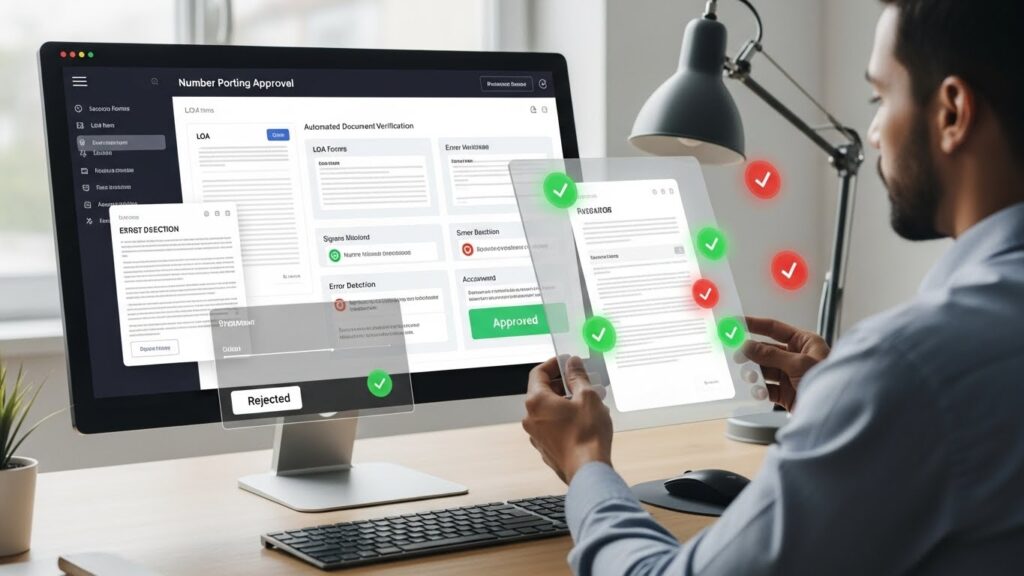
Contactivity solution: Pre-submission document review service validates information before carrier submission. Interactive checklist flags common errors automatically. LOA template with auto-fill guidance prevents formatting mistakes. Common error detection catches name mismatches, account discrepancies, and signature issues. Result: Rejection rate below 5%.
Unclear Timeline
Industry problem: Providers give vague “7-10 business day” estimates without progress updates, leaving customers uncertain about completion dates.
Contactivity solution: Specific estimated completion date provided at request submission. Real-time status dashboard shows current phase and next milestones. SMS notifications at validation, carrier coordination, and execution phases. Proactive communication if delays occur with updated estimates. Result: Complete visibility into port status at all times.
Losing Carrier Non-Cooperation
Industry problem: Some carriers delay or obstruct porting to retain customers, causing extended timelines and customer frustration.
Contactivity solution: Established relationships with major carriers accelerate coordination. FCC regulation expertise enforces compliance when carriers delay unreasonably. Escalation protocols for resistant carriers involve regulatory authority when necessary. Direct carrier coordination eliminates customer involvement in disputes. Result: 92% on-time completion rate.
Service Interruption Fears
Industry problem: 18% of businesses experience call disruptions during porting due to inadequate technical safeguards.
Contactivity solution: Redundant routing configuration creates backup pathways. Advance call forwarding setup before port execution. Off-hours port scheduling minimizes potential impact. Real-time monitoring with immediate response capability. Rollback procedures if technical issues arise. Result: 99.99% uptime maintained throughout porting.
Multi-Number Complexity
Industry problem: Businesses with 5+ numbers face coordination challenges, documentation confusion, and extended timelines.
Contactivity solution: Batch porting capability handles up to 50 numbers simultaneously. Staggered port option available for risk mitigation preferences. Single point of contact manages all numbers in the request. Coordinated validation across all lines in one review cycle. Result: Efficient multi-line migration in single 4-5 day window.
Frequently Asked Questions
Can I keep my current business phone number if I switch to Contactivity?
Yes. Number porting transfers your existing phone number to Contactivity’s VoIP system within 3-7 business days without changing the number digits. The FCC-regulated Local Number Portability process maintains your established brand identity and customer contacts. Contactivity handles all carrier coordination, ensuring seamless migration with zero service interruption throughout the transition.
How long does number porting take?
Number porting to Contactivity typically completes within 3-7 business days from request submission. The timeline includes validation (1-2 days), carrier coordination (2-4 days), and port execution (scheduled date). Contactivity’s average completion time is 4.5 business days, faster than the 6-8 day industry average. Same-day validation accelerates the process for requests submitted before 2 PM EST.
Will I miss calls during number porting?
No. Contactivity guarantees zero downtime during number porting through redundant routing configuration and advance call forwarding setup. The port execution occurs at the network level with seamless transition, ensuring all incoming calls route correctly throughout the process. Contactivity’s 99.99% uptime guarantee extends through the entire porting period, with real-time monitoring to prevent any service interruption.
What documents are required for porting?
Number porting requires a signed Letter of Authorization (LOA), current phone bill within 30 days, account number from your existing provider, and account PIN or password if required. Contactivity provides an LOA template and conducts pre-submission document review to ensure accuracy. The business name must match your current provider’s records exactly to prevent rejection delays.
Is there a fee to port my number to Contactivity?
No. Contactivity charges $0 port-in fees for both local and toll-free numbers, with no setup charges or administrative costs. Your current provider may charge port-out fees ($5-$50 per number) or early termination fees if under contract, but Contactivity adds no additional porting fees. This represents $130-$190 savings compared to VoIP providers charging $10-$30 per number.
Can I port toll-free numbers to Contactivity?
Yes. Contactivity supports toll-free number porting for 800, 888, 877, 866, 855, 844, and 833 prefixes. Toll-free porting follows the same process as local numbers but requires Responsible Organization (Resp Org) verification. The timeline is typically 3-7 business days with the same zero-downtime guarantee. Contactivity coordinates all Resp Org database updates.
What happens if my port request is rejected?
Contactivity’s pre-submission validation reduces rejection rates to below 5% compared to the 22% industry average. If rejection occurs due to losing carrier issues, Contactivity’s porting specialists immediately identify the discrepancy, provide specific correction requirements, and resubmit the corrected request within 24 hours. Common rejection causes include name spelling mismatches, incorrect account numbers, or outdated bills.
Can I port multiple phone numbers at once?
Yes. Contactivity supports batch porting for up to 50 numbers simultaneously with coordinated execution on a single port date. For businesses requiring 5+ number ports, Contactivity offers staggered port options to mitigate risk, with sequential groups ported across multiple dates. Multi-number porting includes no additional fees and maintains the same dedicated specialist support throughout the process.
Will my voicemail and call settings transfer during porting?
No. Voicemail messages and call routing settings do not automatically transfer during number porting. Contactivity provides new voicemail and call management features through its VoIP platform, allowing configuration of auto-attendants, call forwarding rules, voicemail-to-email, and advanced routing. The porting specialist guides setup of equivalent or enhanced features, ensuring business continuity with improved functionality compared to legacy systems.
What if I’m currently under contract with my provider?
You can still port your number to Contactivity even under contract, as LNP is a federally protected right under FCC regulations. However, your current provider may charge early termination fees (ETFs) based on your contract terms. Contactivity’s porting specialists review your existing contract and calculate total switching costs, helping determine if savings with Contactivity offset ETFs within your first year of service.
Ready to Keep Your Business Number?
Number porting enables small businesses to upgrade from outdated phone systems to Contactivity’s advanced VoIP platform without sacrificing brand identity or customer relationships. The 3-7 business day process maintains service continuity through zero-downtime engineering, allowing seamless migration with no missed calls or operational disruption.
Contactivity’s dedicated porting specialists, 95% first-attempt success rate, and comprehensive documentation support distinguish the service from competitors charging $10-$30 per number while providing limited guidance. Small business owners concerned about customer continuity and IT managers requiring predictable timelines trust Contactivity’s proven porting process to maintain communication reliability during critical provider transitions.
Ready to keep your business number while experiencing Contactivity’s superior VoIP service? Contact our porting specialists today for a free consultation and timeline estimate. Our team will review your specific requirements, validate eligibility, and guide you through every step of the seamless migration process.
Start Your Number Port Today | Speak with a Porting Specialist | Download Porting Checklist