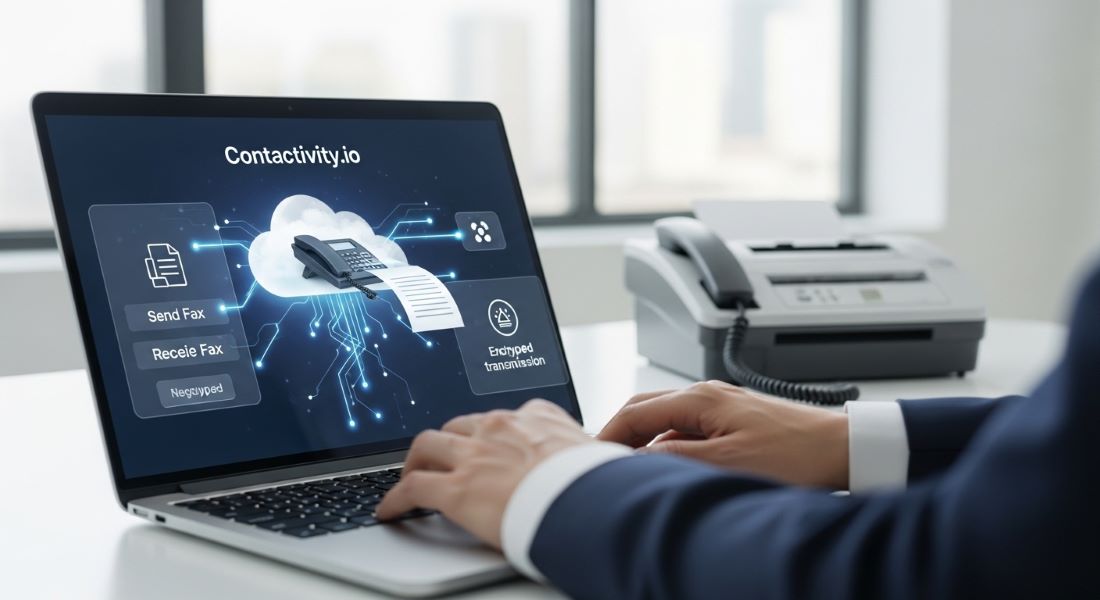
Almost all business communication methods today in modern companies have been changed by digital transformation. Our organization has adopted a unified communications system which replaces desk phones while we use cloud storage to replace physical file cabinets and our system runs on distributed networks instead of local servers.
People see the fax machine as an outdated 1980s technology which should not exist in the present day world of fiber optic internet. The healthcare sector and legal services and financial institutions and government contracting organizations all require faxing because it serves as their mandated security standard.
The answer to the problem exists as a Fax Over IP (FoIP) technology solution. Businesses can use Contactivity.io to implement FoIP which allows them to meet their 20th century regulatory requirements through 21st century operational methods.
Understanding the Anatomy of Fax Over IP (FoIP)
To appreciate why FoIP is the future we must first understand how it differs from the past. Traditional faxing relies on the Public Switched Telephone Network (PSTN). It sends data as continuous analog signals over copper wires. While reliable for decades this method is increasingly incompatible with modern digital networks.
The Technical Mechanism
FoIP works by “packetizing” fax data. Instead of a continuous stream of sound the document is broken down into digital data packets transmitted over an IP network (the internet or a private intranet) and reassembled at the destination.
The gold standard for this process is the T.38 protocol. Unlike older methods like “G.711 pass through” which essentially tries to “trick” a voice line into carrying fax audio T.38 is designed specifically for data. It includes error correction mechanisms that account for the slight delays (latency) or data loss (jitter) that can occur on the internet ensuring that the document arrives exactly as it was sent.
The Business Case: Why Transition to FoIP?
For a business operating on Contactivity.io the transition to FoIP offers four primary pillars of value: Cost Security Mobility and Infrastructure.
A. Eliminating the “Analog Tax”
Maintaining traditional analog phone lines (POTS lines) is becoming a massive financial drain. Carriers are aggressively phasing out copper infrastructure leading to skyrocketing monthly costs for the few lines that remain. FoIP utilizes your existing broadband connection. By moving faxing to the cloud you eliminate:
- Monthly analog line rental fees.
- Long distance charges for international transmissions.
- Maintenance costs for physical fax hardware (toner paper drum units).
B. Security and Regulatory Compliance
In many sectors email is not considered “secure enough” for the transmission of highly sensitive data. Faxing remains a preferred method because it provides a point to point audit trail. FoIP takes this security to the next level.
- Encryption: Data is encrypted in transit and at rest.
- Access Control: No more sensitive medical records or legal contracts sitting in an open tray in the office breakroom. Faxes are delivered directly to secure digital inboxes.
- Digital Logs: Every fax sent or received generates a digital footprint making audits and compliance reporting significantly easier.
C. Workforce Mobility
The modern workforce is no longer tethered to a desk. Whether your team is working from home in a satellite office or on the road they need access to business tools. FoIP transforms faxing into a mobile service. Through a web portal or email integration an employee can send a signed contract from their laptop in a coffee shop as easily as if they were standing in the main office.
Implementation Strategies with Contactivity.io
How does a business actually make the switch? There are generally three paths to modernization depending on your current setup.
Option 1: The ATA Bridge (Legacy Support)
If your office still loves its physical fax machine you don’t have to throw it away. An Analog Telephone Adapter (ATA) acts as a translator. You plug your old fax machine into the ATA and the ATA connects to your internet router. It converts the analog signals into IP packets for transmission through the Contactivity.io network.
Option 2: Email to Fax
This is the most popular choice for modern offices. To send a fax you simply compose an email attach your PDF and address it to [RecipientNumber]@faxprovider.com. When a fax is sent to you it arrives in your inbox as a PDF attachment. This requires zero hardware and fits perfectly into existing workflows.
Option 3: API Integration
For high volume businesses or software developers FoIP can be integrated directly into applications via an API. Imagine your CRM automatically faxing an order confirmation to a supplier the moment a deal is closed. This level of automation is only possible through a cloud based IP framework.
Technical Best Practices for a Seamless Experience
While FoIP is powerful it does require proper configuration to ensure “five nines” reliability.
Network Optimization
Faxing is more sensitive to network conditions than voice calls. While a slight “crackle” on a voice call is annoying, a slight “jitter” in a fax transmission can cause the entire page to fail.
- Quality of Service (QoS): Configure your office router to prioritize fax data packets.
- Bandwidth Management: Ensure your upload speeds can handle simultaneous faxing and high def video conferencing.
The Role of SIP Trunking
FoIP is most effective when integrated into a broader SIP Trunking strategy. By consolidating your voice and fax services into a single IP stream through a provider like Contactivity.io you simplify your billing and reduce the number of potential failure points in your communication chain.
Industry Specific Benefits
Legal and Professional Services
In the legal world “proof of delivery” is everything. FoIP provides timestamped digital confirmation receipts that are legally defensible. Furthermore the ability to quickly fax signed affidavits or court filings from a laptop can give a firm a competitive edge in fast moving cases.
Healthcare (HIPAA Compliance)
Healthcare providers are legally mandated to protect patient privacy. Traditional faxing is often the weak link in the security chain. FoIP allows for secure encrypted transmission of Patient Health Information (PHI) directly into Electronic Health Record (EHR) systems reducing the risk of a data breach.
Real Estate and Logistics
These industries are document intensive and time sensitive. FoIP ensures that closing documents or bills of lading are transmitted instantly regardless of the recipient’s location, preventing delays in closings or shipments.
Conclusion
The move to Fax Over IP is not just about keeping a legacy technology alive; it is about bringing that technology into the modern age. It is about taking a process that was once manual, expensive and stationary and making it automated cost effective and mobile.
As you look to optimize your business operations on Contactivity.io don’t let your faxing needs remain in the analog past. By embracing FoIP you ensure that your business remains compliant, secure and ready for the future of work.
FAQs
Is FoIP as reliable as a traditional analog fax machine?
Yes, by using the T.38 protocol, FoIP provides high reliability and error correction that overcomes internet stability issues.
Do I need to buy new hardware to use FoIP?
No, you can use existing machines with an Analog Telephone Adapter (ATA) or send faxes digitally via email and web portals.
Can I keep my existing fax number?
Yes, most existing fax numbers can be ported to Contactivity.io through Local Number Portability (LNP) without service interruption.
How does FoIP improve HIPAA and legal compliance?
FoIP uses encryption and direct digital delivery to prevent unauthorized access, while providing a secure digital audit trail.