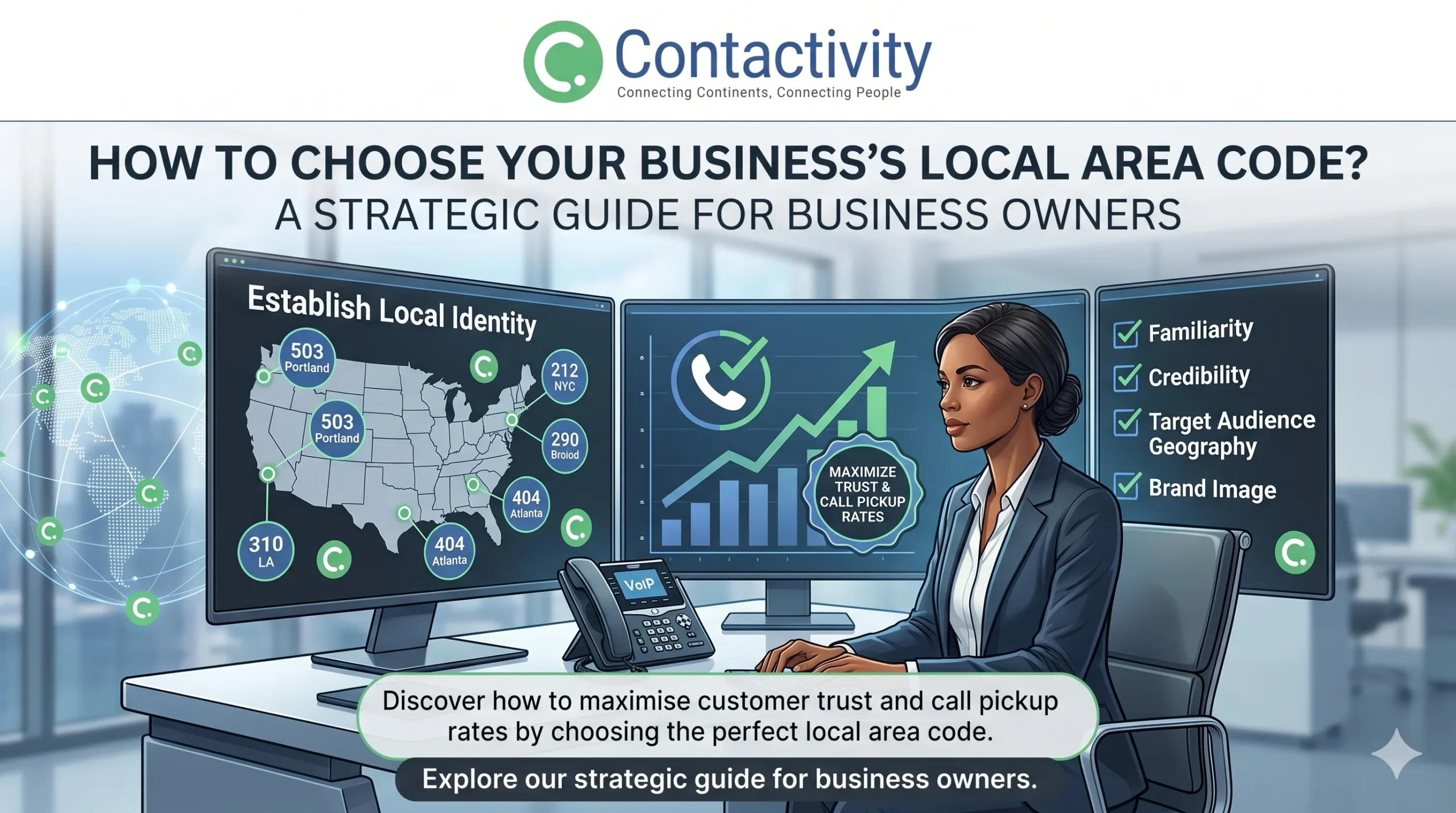
Imagine you are Sarah, a small business owner who just expanded her consulting firm to serve clients in three different cities. She knows she needs local phone numbers, but she is staring at a list of available area codes with no clear idea of which ones to pick. Does it really matter?
The answer is a firm yes. The area code attached to your business phone number is not just a routing prefix. It is a first impression, a trust signal, and a geographic statement that shapes how customers perceive your brand before they ever hear your voice.
This guide walks you through every strategic consideration you need to make an informed, confident choice when selecting a local area code for your business through Contactivity’s Local Number Services.
What Is the Purpose of a Business Area Code?
Most business owners treat an area code as a technicality. In reality, it carries meaningful weight in customer decision-making. Research consistently shows that people are far more likely to answer a call or trust a business that displays a number matching their own region. A familiar three-digit prefix communicates that you are local, accessible, and invested in the community.
For small and medium-sized businesses, this psychological edge can translate directly into higher call pickup rates, stronger brand credibility, and better conversion from marketing campaigns. Choosing the right area code is not about vanity. It is about positioning your business in the minds of the customers you most want to reach.
Key Strategic Considerations When Choosing a Local Area Code
There is no single correct answer for every business. The best area code for your company depends on a combination of the following factors.
1. Geographic Targeting: Where Are Your Customers Located?
The most fundamental consideration is geography. Your area code should align with the market you are actively trying to serve. If the majority of your customers are based in a specific city or metro area, choosing a number with that region’s area code immediately signals local relevance.
Many cities now have multiple overlapping area codes due to population growth and demand for numbers. A city might have both a legacy code that longtime residents recognise and a newer overlay code. Understanding which code feels more native to your target audience is worth researching before you commit.
If your business serves multiple markets, the good news is that you can acquire separate local numbers for each region. Through Contactivity’s Local Number Service, businesses can select area codes from thousands of geographic regions, making it straightforward to establish a local presence in every city you serve.
2. Brand Perception: What Impression Does Your Number Create?
Your area code contributes to your overall brand image. A number from a major metropolitan area like New York (212 or 646), Los Angeles (213 or 310), or Chicago (312) can lend a sense of prestige and scale, even if your physical office is elsewhere. Businesses that want to project a big-city presence often choose these iconic codes for that reason.
On the other hand, if your brand story centres on being a trusted neighbourhood business, a hyperlocal code for a smaller city or specific region will feel more authentic. The question to ask is: what does my ideal customer expect from a business like mine, and does my phone number reinforce that expectation?
3. Customer Psychology: Familiarity Drives Call Pickup
One of the most practical reasons to choose a local area code is the call answer behaviour. Studies show that people screen calls aggressively, and a number they do not recognise with an unfamiliar area code is far more likely to be ignored. When your outbound calls display a number that matches the recipient’s own region, pickup rates increase substantially.
This is especially important for sales teams making outbound calls or customer service teams handling follow-ups. Using a local number from Contactivity means your team appears native to the markets they are calling, removing that critical first barrier to connection.
4. Number Availability: Not Every Code Has Open Inventory
In high-demand metro areas, certain local area codes can have limited availability, particularly if you have specific preferences for the number sequence itself. This is an important practical consideration. Before committing your strategy to a specific area code, it is essential to verify that numbers are actually available in that region.
Contactivity maintains an extensive inventory of local DID (Direct Inward Dialling recognition) numbers across thousands of area codes, making it one of the most flexible options for businesses that need specific geographic coverage. Their team can help you identify what is available and suggest strong alternatives if your first-choice code has limited stock.
5. Vanity Considerations: Making Your Local Number Memorable
While vanity numbers that spell out a word are more commonly associated with toll-free lines, the principle of memorability applies to local numbers too. When choosing from available number sequences, look for patterns that are easy to remember, such as repeating digits or simple sequences that customers can recall without writing them down.
A memorable local number gives you a small but meaningful advantage in word-of-mouth referrals and repeat business. If you ever use your phone number in print advertising, yard signs, or vehicle wraps, a clean and easy-to-recall number sequence makes a real difference.
If a full vanity number is important to your brand, you might also explore whether a toll-free vanity number alongside a local number could serve complementary purposes for your marketing strategy.
6. Porting Existing Numbers: You May Not Need to Start From Scratch
If you already have a local number that your customers know, you do not necessarily need to abandon it when switching to a modern VoIP platform. Number porting allows you to bring your existing local number to Contactivity, preserving the local area code and number sequence your customers already recognise and trust.
This is particularly valuable for established businesses with strong brand recognition tied to their phone number. Porting ensures continuity and means your customers never experience any disruption during the transition. Contactivity supports number porting as part of its local number service, making the switch smooth and low-risk.
Building Your Area Code Selection Strategy: A Practical Framework
Follow these steps to move from uncertainty to a clear, well-justified area code decision.
• Map your customer geography. Pull your customer data and identify which cities or zip codes generate the most business. Your primary area code should serve your highest-concentration market.
• Define your brand positioning. Decide whether you want to project local familiarity or metropolitan credibility, then choose an area code that aligns with that positioning.
• Check availability before finalising RMD-registered. Reach out to Contactivity to confirm that numbers with your preferred area code are in stock. Have a backup code in mind for the same region.
• Consider multi-market expansion. If you plan to grow into new cities within the next 12 months, acquire those local area codes now. It is far easier to have numbers ready than to set them up mid-campaign.
• Evaluate porting if you have existing numbers. If customers already know your number, porting it to Contactivity preserves that recognition while upgrading your underlying communication platform.
Common Mistakes Businesses Make When Choosing an Local Area Code
• Choosing randomly without a geographic rationale. Picking any available number without thinking about your target market undermines the trust-building value that a local number is meant to provide.
• Assuming one number serves all markets. If your business actively serves multiple cities, a single area code will feel unfamiliar to customers in other regions. Multiple local numbers are the correct solution.
• Overlooking overlay area codes. Major cities often have newer overlay codes that younger residents and businesses use by default. Picking only the legacy code may not reach the audience you intend.
• Failing to plan for number portability. If you are locked into a number through a traditional provider with no porting support, switching later becomes painful. Contactivity’s platform is built with portability in mind from the start.
How Contactivity Helps You Find and Secure the Right Area Code?
- Access an extensive inventory: Get local numbers from thousands of area codes across the United States and beyond with their Local Number Service.
- Enjoy a straightforward setup: Simply choose the area codes for your target markets, and Contactivity will activate your numbers and configure call routing so you can start connecting with local customers immediately.
- Port existing numbers easily: If you’re already using local numbers, Contactivity handles the porting process with minimal disruption.
- Integrate with powerful VoIP features: Your local lines come with features like auto-attendant, call forwarding, voicemail-to-email, and HD call quality.
- Complement with toll-free numbers: If you’re unsure about a local number strategy, Contactivity also offers Toll-Free Number Services for customer service or national marketing campaigns.
Making Your Final Decision: Key Questions to Ask
Before you finalise your area code selection, run through these questions to validate your choice.
• Which city or region generates the most revenue for my business right now?
• Are the customers I most want to call back likely to recognise and trust this area code?
• Do I need more than one local area code to cover my key markets effectively?
• Am I planning to expand geographically within the next year, and should I secure those codes proactively?
• Do I have an existing number with strong customer recognition that should be ported rather than replaced?
Conclusion: Your Area Code Is a Strategic Investment
For business owners like Sarah, the area code decision is an early and important step in building a communication strategy that supports growth. The right local area code signals geographic relevance, builds trust with regional customers, improves call pickup rates, and strengthens your overall brand perception in the markets that matter most.
The strategic considerations covered in this guide, including geographic targeting, brand perception, number availability, vanity memorability, and porting, all deserve thoughtful attention. None of them is overly complex, but taken together, they can make a meaningful difference in how effectively your business connects with the people it wants to serve.
Ready to find the perfect local area code for your business? Get in touch with Contactivity today to explore available numbers, discuss your geographic strategy, and get your local presence set up quickly. You can also explore the full range of business communication solutions Contactivity offers to support your growth at every stage.